In this article
Illustrative photo by Vitaly Gariev / Unsplash.
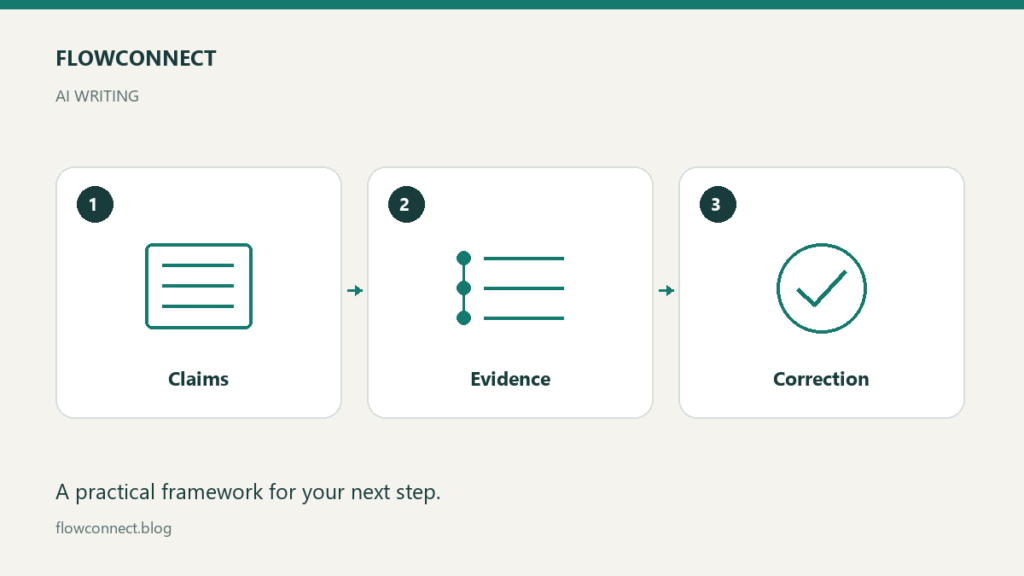
Fact-check an AI-assisted draft by checking its claims against evidence, not by asking the same tool whether the article is correct. Start with the statements that could mislead a reader, change a purchase decision or damage someone’s reputation. Then verify the simpler details.
The workflow below is a suggested editorial process. It does not certify an article or replace qualified review of medical, legal or other specialist material.
Make a claim ledger
Read the draft once and copy checkable statements into a separate document. Include statistics, dates, quotations, product features, prices, comparisons and claims about what a company or person did. General transitions do not need a research entry; “this plan includes unlimited storage” does.
Use five fields: claim, source, date checked, limitations, decision. Your decisions can be keep, qualify, replace or remove. A link alone is not enough: record the sentence or section that actually supports the claim so another editor can follow your reasoning.
Match evidence to the claim
For a software feature, begin with the vendor’s current documentation and the relevant plan. For a study, look for its methods, sample and publication date. An article repeating a statistic may help you locate the original research, but it should not become the source merely because it is easy to find.
A statement about a survey of employees should not become a claim about all businesses. A vendor’s promise should not become your own tested conclusion. If the evidence supports a narrower sentence, narrow the sentence.
Work through a small example
Suppose a draft says: “This automation saves every freelancer five hours each week.” Your ledger has no measurement, sample or method. The honest fix is not to attach an unrelated automation report.
Replace the claim with an instruction: “Measure preparation, review and correction time before deciding whether the automation helps.” If you later run a documented test, describe its task, conditions and limits. One test still does not establish what every freelancer will experience.
Check quotations and links separately
Open each cited page. Confirm that it exists, says what the article claims and is appropriate for the context. Check quoted words against the original and distinguish a direct quotation from your summary. Remove quotes that cannot be traced.
Next, test internal links. A relevant guide should move the reader forward; a working link to an unrelated article does not improve the explanation. Inspect the anchor text too: it should describe what someone will find after clicking.
Finish with a publication gate
Article:
Claims that need sources:
Unresolved questions:
Product details checked on:
Quotations checked against originals:
Links checked:
Examples labelled actual or hypothetical:
Reviewer and decision:
Keep unresolved claims out of the published version. Save the ledger with the draft so a later update does not restart the research from nothing. If an error appears after publication, correct the relevant text and add a clear note when the change materially affects what readers were told.
Your goal is a useful article with traceable reasoning. A confident tone, a long bibliography or a high score from another automated checker cannot substitute for that work.