In this article
Illustrative photo by Kelly Sikkema / Unsplash.
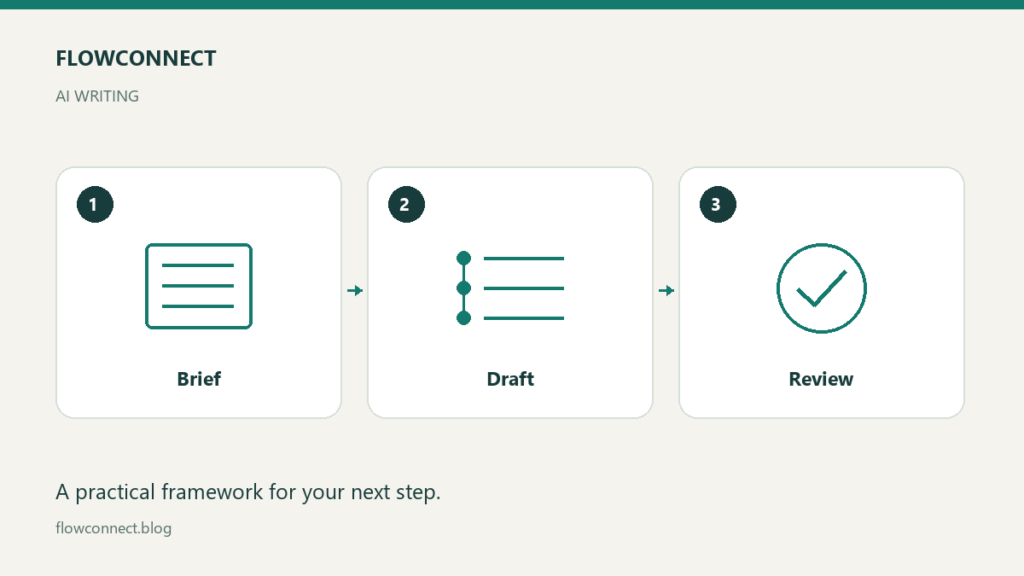
An AI writing brief gives a drafting tool the information it needs before you ask for sentences. A useful brief defines the reader, the job of the piece, approved facts and what the tool must leave unanswered. You can reuse the structure while replacing the facts for each assignment.
This tutorial uses an illustrative newsletter for a freelance web designer. It is an editorial method, not a claim that a particular AI product produces accurate copy without review.
Start with a reader and one outcome
Write a specific audience description: “Owners of small service businesses who already have a website but struggle to keep it current.” Then define the intended action: “Choose one page to review this week.” This is more actionable than asking for engaging content about websites.
Set a boundary around the assignment. A 400-word newsletter about reviewing a contact page does not need a complete history of web design, a list of every marketing channel or a product recommendation. Put those exclusions in the brief to reduce irrelevant drafting.
Separate facts from instructions
Keep approved information in its own section. For the example, that might contain the actual service scope, a verified contact URL and the steps in your own review process. Do not place guesses about conversion improvements beside confirmed facts.
If a number has no source, omit it or mark it as a question for the editor. A model can make an invented percentage sound polished. Clear wording is not evidence that a claim is true.
Copy this brief
Reader: [Who will use this?]
Reader's problem: [One concrete problem]
Outcome: [What they should know or do]
Format and length: [Newsletter, guide, checklist]
Approved facts: [Facts and source URLs]
Original example: [Your actual or clearly hypothetical example]
Structure: [Answer, steps, example, next action]
Voice: [Plain language; no exaggerated promises]
Do not invent: Prices, statistics, quotes, customers or test results
Unknowns: List missing facts separately for the editor
Final action: [One relevant next step]
Keep confidential client material out of the example unless you have an appropriate basis to use it and have checked the tool’s data settings. For a general writing exercise, fictional details are usually sufficient.
Ask for an outline before a draft
Read the outline as if you were the intended customer. Does it answer the question in the opening? Do the steps lead to the promised outcome? If the structure is wrong, revise it before generating paragraphs. This makes the review task smaller.
For the contact-page example, an outline could be: check the contact method, send a test inquiry, confirm who receives it, and record the next review date. The newsletter then serves a practical purpose instead of describing why websites matter in general.
Review and version the brief
Check every link, factual assertion and instruction in the finished draft. Remove claims that are stronger than the evidence. Keep a short change log: “Version 2 requires a concrete example” is more useful than remembering that the first output felt generic.
Save the brief separately from generated drafts. That lets you improve the reusable instructions without accidentally carrying old prices or outdated service details into the next article. Your first successful version is the one that makes review easier while producing something the reader can use.