In this article
Illustrative photo by Bluestonex / Unsplash.
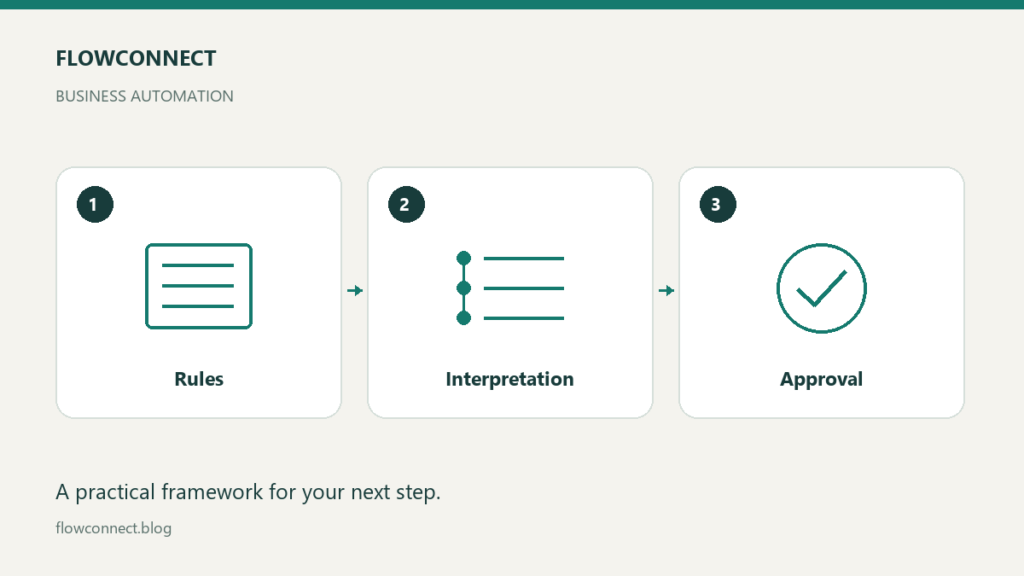
Use fixed rules when you can describe the steps and conditions reliably. Consider an AI-assisted or agent-based approach when the task requires interpreting variable information, and only when you can check the result and contain mistakes. Some workflows need a combination of the two.
The following decision method is an editorial framework, not a performance comparison of named platforms.
Define what varies in the task
A form submission with a required email field and a selected service is relatively structured. A free-form message describing a vague business problem requires more interpretation. Do not add an agent merely because a task happens frequently; repetition alone can favor straightforward automation.
Anthropic’s Building effective agents distinguishes predefined workflows from systems in which a model directs its steps. The article is from December 2024 and notes that its tooling discussion has evolved. Its architectural distinction is useful here; it is not current pricing or a product recommendation.
Compare three possible designs
| Design | Illustrative use | What to check |
|---|---|---|
| Fixed rules | Route a selected service to its owner | Missing fields and incorrect conditions |
| AI assistance | Draft a summary of an inquiry | Omissions and invented details |
| Agent workflow | Choose among permitted research steps | Tool access, decisions and stopping behavior |
There is no requirement to move down the table as your business grows. A clear rule can remain the right solution indefinitely.
Work through a customer inquiry
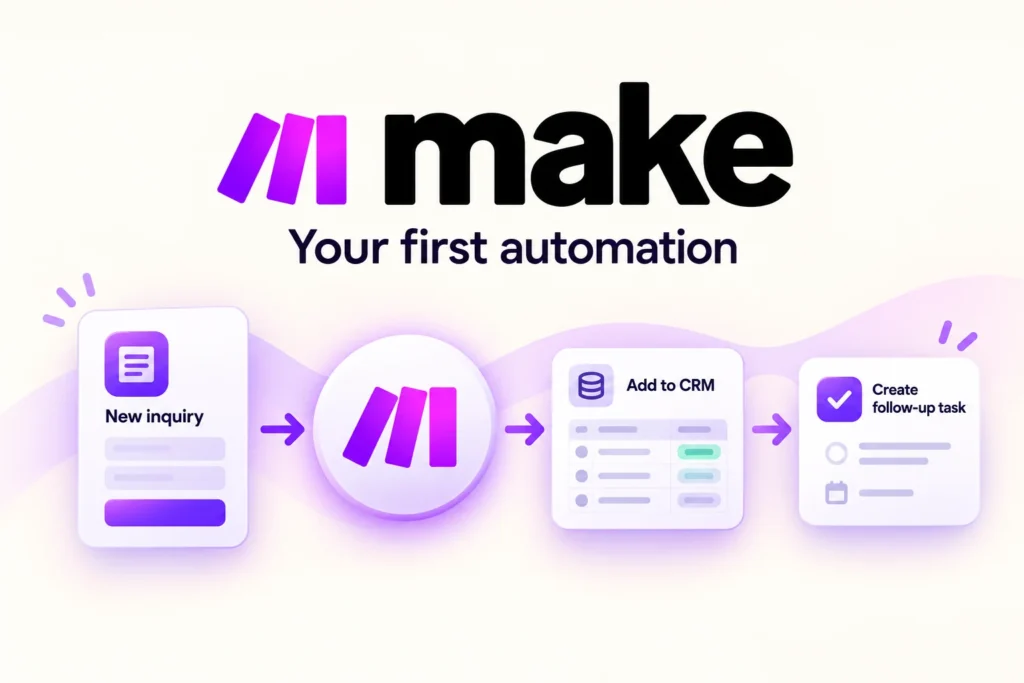
For an illustrative consulting intake, first validate required form fields with ordinary rules. Next, store the inquiry in the approved destination. An AI step could prepare a summary for the consultant, but a person should verify it before replying or making commitments.
If the message contains conflicting details, the system should flag the uncertainty rather than choose a convenient interpretation. A summary saying “budget not provided” is more useful than one inventing a budget that makes the record look complete.
Set limits before adding autonomy
Define allowed tools, records, actions and a stopping condition. Keep external sending and financial decisions behind approval when mistakes would have consequences. Logs should make it possible to reconstruct what happened without unnecessarily exposing sensitive data.
Specify how the workflow handles unavailable services, unexpected inputs and duplicate events. For example, processing the same inquiry twice should not create two client commitments. These questions matter whether or not the workflow uses AI.
Evaluate the whole process
For a small pilot, record attempts, accepted results, usage charges, review minutes and cases requiring human approval. Calculate cost per accepted result, including failed attempts and corrections. For subscriptions, include a reasonable share of the recurring fee as well as usage charges. Compare completion time and acceptable error levels with the existing process.
Compare the original task with the proposed system using representative examples, including difficult ones. Record review time, corrections, operational cost and failures. A fast draft that takes longer to repair is not a useful time saving.
Keep the design that makes the work more dependable within an acceptable effort and cost. Start with a bounded task, retain an understandable fallback, and expand only after the observed results justify it. If a rule, checklist or draft-only assistant solves the problem, that is a complete solution.