In this article
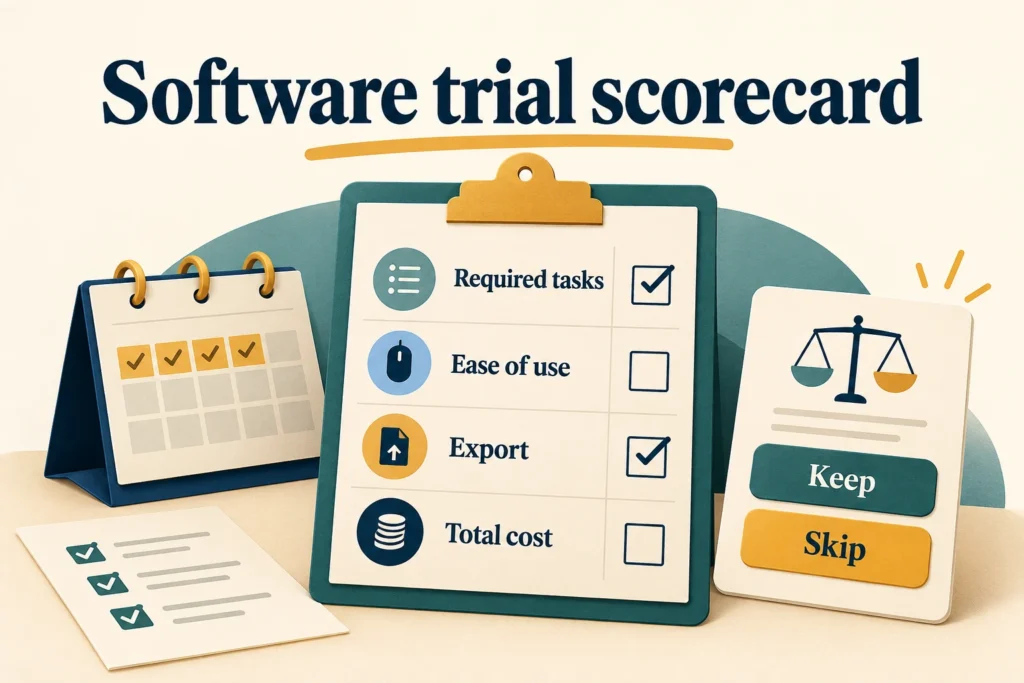
AI-assisted editorial illustration. Layouts are conceptual, not product screenshots.
A software trial should answer whether a tool can do your work at an acceptable cost and effort. A tour of its features answers a different question. Pick representative tasks, define what counts as success and record where the candidate helps or creates extra work.
Write the pass-or-fail requirements first
List the capabilities you cannot operate without. For a small client database, those might include exporting records, restricting access and assigning the next action. Separate these from preferences such as a particular dashboard layout.
Use your own requirements rather than a vendor’s comparison table. If a tool fails an essential requirement, a high score for attractive extras should not hide that failure. Ask the vendor to clarify an uncertain feature instead of assuming it is included in the plan you intend to buy.
Build a small test packet
Use fictional or appropriately sanitized data. An illustrative client-follow-up trial might contain three inquiries: a new contact, an existing client asking for another service and a duplicate message. Include a missing field so you can see what the system does when the input is imperfect.
Write the tasks before opening the application: create a record, find its history, assign a next action, hand it to another person and export the result. Use the same packet for each candidate. This makes comparisons more meaningful than trying unrelated features in each product.
Score observable results
| Task | Pass condition | Result to record |
|---|---|---|
| Create a record | Required details remain accurate | Time, missing fields, extra steps |
| Hand off work | Next owner sees the context | Questions or duplicate entry |
| Export information | Needed data is usable elsewhere | Missing notes, files or relationships |
A simple scoring rule is zero for not completed, one for completed with an awkward workaround and two for completed acceptably. These are suggested internal labels, not validated product ratings. Add notes explaining each score; a number alone can conceal an important limitation.
Include an exit test and the recurring cost
Download an export and inspect it. Can you understand the fields? Are attachments or notes separate? Could another person reconstruct the records without access to the original account? A download button does not guarantee a useful migration path.
Check current plan documentation for limits, billing conditions and access to the features you used. Trial access may differ from the plan you will purchase. Include setup, training, maintenance and review effort alongside subscription and usage charges. Record renewal terms rather than comparing only introductory prices.
Make a decision you can revisit
Essential requirements: pass / fail / unresolved
Representative tasks tested:
Main limitations:
Expected recurring cost and effort:
Export inspected: yes / no
Decision: adopt / extend evaluation / reject
Reason and date to review:
If a decisive requirement remains unresolved, seek an answer or continue with your current system while you evaluate it. Do not buy merely because the trial is ending. If you choose the tool, move a limited set of work first and check that the real process matches the trial.
Keep the scorecard as a record of your decision. When your needs change, it explains why the earlier choice made sense and what should be tested next. The objective is a suitable tool, not a winner that must remain best forever.